Art
Subject Leader - Miss. A. Wallwork
Intent, Implementation, Impact
Intent
At Haslam Park Primary School, we believe that Art and Design is central to every child’s education. It provides pupils with a powerful way to express identity, reflect on their lived experiences, and interpret the world around them. Our curriculum is ambitious, inclusive, and designed to ensure that every pupil, regardless of background or starting point, can access high-quality artistic experiences that develop both creativity and knowledge. We deliver our curriculum through Kapow Primary, a progressive, creative, and knowledge-rich scheme. Pupils systematically develop disciplinary knowledge (understanding artists, styles, movements, and cultural contexts) and substantive knowledge (skills in drawing, painting, sculpture, craft, and design), enabling them to think, create, and work as artists. The curriculum draws on local, regional, and global artistic influences, including a diverse range of artists, designers, and makers, helping pupils understand how art reflects culture, identity, and social change. Creativity is taught, practised, and refined, enabling pupils to take risks, experiment with materials, and articulate ideas confidently using subject-specific vocabulary. Our commitment to Artsmark Silver underlines our dedication to high-quality, inclusive arts provision that inspires creativity, cultural awareness, and engagement with the wider community.
Implementation
Art is taught through the structured progression of Kapow Primary, ensuring clear sequencing and spiral progression from Early Years through Year 6. Lessons are practical, exploratory, and skills-focused, enabling pupils to build on prior learning and revisit key concepts with increasing complexity. Daily review and retrieval activities are embedded in lessons to activate prior knowledge, strengthen long term memory, and enable pupils to apply previous learning in new contexts. Across KS1 and KS2, the curriculum is delivered through five key strands:
- Generating ideas
- Using sketchbooks
- Making skills, including formal elements (line, shape, tone, texture, pattern, colour)
- Knowledge of artists and cultural contexts
- Evaluating and analysing
These strands are developed through four core areas: drawing, painting and mixed media, sculpture and 3D, and craft and design. Teachers adapt lessons to meet the needs of all pupils, including SEND, ensuring that everyone can access the curriculum while providing opportunities to stretch and challenge higher-attaining learners. Knowledge organisers support factual recall, and cross-curricular links allow pupils to integrate learning across subjects. CPD, clear guidance, and step-by-step lesson plans from Kapow ensure that teachers are confident in delivering both practical skills and conceptual understanding.
Impact
The impact of our art curriculum is evident in pupils’ skills, creativity, confidence, and knowledge retention. Regular retrieval and revisiting of prior knowledge ensures pupils remember and apply learning over time, and can transfer skills across projects. Pupils demonstrate secure progression in drawing, painting, sculpture, and design, and can articulate ideas and evaluate work using subject-specific vocabulary.
By the end of Key Stage 2, pupils:
- Produce purposeful, creative outcomes with increasing control and precision
- Analyse and evaluate their own work and that of others thoughtfully
- Show resilience, independence, and confidence in creative problem-solving
- Understand how art reflects diverse cultures, historical periods, and communities
- Make connections between their own work and the wider world Sketchbooks provide evidence of progression, experimentation, and refinement of techniques, while pupil voice reflects enjoyment, engagement, and the ability to articulate learning.
Leaders monitor implementation through lesson visits, book scrutinies, pupil discussions, and assessment data, ensuring consistency and identifying gaps for targeted support.
Impact is measured via our approach to foundation subject assessment which is designed to measure retention. Assessment follows a clear cycle of curriculum coverage, daily reviews, end-of-year ‘Mastermind’ quizzes, targeted teaching and retesting. Daily reviews support knowledge retention, while Mastermind quizzes identify gaps and misconceptions. Teachers address these through targeted teaching in the following autumn term, with spring retests used to evaluate the impact of this approach and check longer-term retention. Ongoing pupil voice, with targeted participation from SEND and disadvantaged pupils, provides further quality assurance of teaching, understanding and retention. As a result, pupils not only meet National Curriculum expectations but develop as creative, reflective, and culturally aware individuals, prepared to continue their artistic journey and actively participate in the wider cultural life of the community. Our Artsmark Silver achievement demonstrates our sustained commitment to excellence, inclusivity, and high-quality arts provision.
Haslam Park is an Artsmark School

Intent
At Haslam Park we value Art and Design as an important part of the children’s entitlement to a broad and balanced curriculum. We aim to inspire pupils and develop their confidence to experiment and invent their own works of Art.
We intend to give pupils every opportunity to develop their ability, nurture their talents and interests, express their thoughts and ideas about the world as well as learning about rich heritage and culture of the British Isles and beyond.
Our Art Offer supports pupils to meet the National Curriculum end of Key stage attainment targets and provides the necessary Knowledge and Skills to ensure Progression across Art & Design competencies.
Haslam Park’s Art Curriculum supports our Artsmark journey inspiring our pupils to create, experience, and participate in a great arts culture.
By the time pupils leave Haslam Park, they will know how art and design reflect our history and contribute to the culture, creativity and wealth of our nation and worldwide.
Implementation
In order to develop their skills as artists, learners will:
- Produce creative work, exploring their ideas and recording their experiences
- Grow in confidence to express themselves through visual means by progressively learning new skills.
- Evaluate and analyse creative works of great artists using specialist vocabulary.
- Empathise with different viewpoints, traditions and cultures, and begin to understand the viewpoint of the diversity of cultures in which they exist.
EYFS
Expressive Arts and Design is weaved into the Daily Provision in the classroom. Opportunities for children to access a wide range of media and materials enables the children to develop their understanding, self-expression, vocabulary and ability to communicate through the arts. There are opportunities throughout the year to focus on specific Artists and Art in other Cultures to develop childrens’ awareness, creativity and imagination.
KS1 & KS2
There are five strands that run throughout the Art Curriculum. These are:
-
Generating ideas
-
Using sketchbooks
-
Making skills, including formal elements (line, shape, tone, texture, pattern, colour)
-
Knowledge of artists
-
Evaluating and analysing
Units of lessons are sequential, allowing children to build their skills and knowledge, applying them to a range of outcomes. The formal elements, a key part of the National Curriculum, are also woven throughout units. Key skills are revisited again and again with increasing complexity in a spiral curriculum model. This allows pupils to revise and build on their previous learning. Units in each year group are organised into four core areas:
-
Drawing
-
Painting andmixed-media
-
Sculpture and 3D
-
Craft and design
The Art Curriculum at Haslam Park is designed to:
-
Developproficiency in using a range of materials creatively to facilitate deeper learning experiences
-
Use drawing, painting,printing and sculpture to develop and share their ideas, experiences and imagination
-
Develop a wide range of art and design techniques in using colour, pattern, texture, line, shape,form and space
-
Explore the work of a range of artists describing the differences and similarities between different practices and disciplines and making links to their own work.
-
Develop techniques, including their use of materials, with creativity,experimentation and an increasing awareness of different kinds of art and design.
-
Create sketch books to record their observations and use them to review and revisit ideas
-
Improve their mastery of art and design techniques, including drawing, painting,printing and sculpture with a range of materials
-
Research great artists, architects and designers in history.
Lessons always practical in nature and encourage experimental and exploratory learning. Art lessons are differentiated wherever possible to ensure that lessons can be accessed and enjoyed by all pupils and opportunities to stretch pupils learning are available when required. Knowledge organisers for each unit support pupils in building a foundation of factual knowledge by encouraging recall of key facts and vocabulary.
Impact
By the time the children at Haslam Park leave our school, they will:
-
Produce creative work, exploring and recording their ideas and experiences.
-
Be proficient in drawing, painting, sculpture and other art, craft and design techniques.
-
Evaluate and analyse creative works using subject specific language.
-
Know about great artists and the historical and cultural development of their art.
-
Meet the end of key stage expectations outlined in the national curriculum for art and design.
The curriculum at Haslam Park is designed in such a way that children are involved in the evaluation, dialogue and decision-making about the quality of their outcomes and the improvements they need to make. By taking part in regular discussions and decision-making processes, children will not only know facts and key information about art, but they will be able to talk confidently about their own learning journey, have higher meta cognitive skills and have a growing understanding of how to improve. Teachers are able to assess pupils against the learning objectives and units of work have a quiz and knowledge catcher which can be used at the start and or end of the unit.
The children are loving learning new Knowledge and Skills through the Kapow Art Scheme. Please look at the gallery below at some of the Art Work Children have completed in Autumn Term 2023 across our school.
Art at Haslam Park Primary School - Autumn 2023
At Haslam Park we work alongside the 'Kapow' scheme which we feel provides a fun, structured and progressive way of learning the necessary knowledge and skills in Art.
Below you will see what the children will learn and how they will go about it.


Here is an example of a Knowledge Organiser for Art.
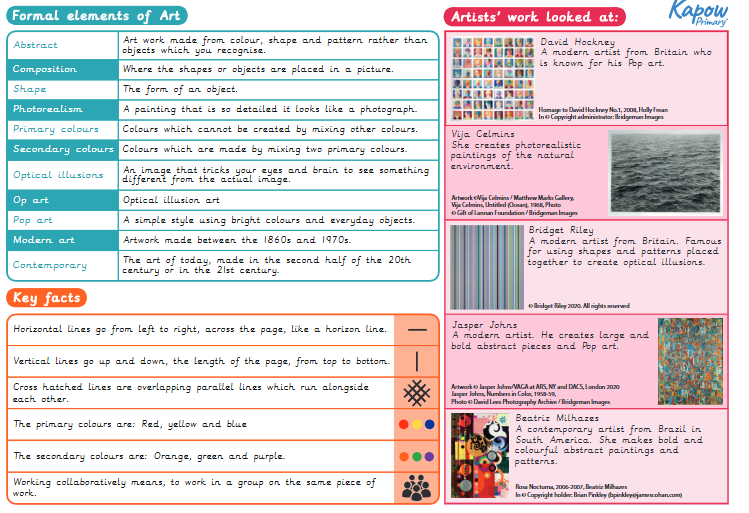
If you want to see in more detail about what each year group will be learning in Art, you can access our Knowledge Organisers by clicking on the link below:
Haslam Park Primary School - Art and Design
Below you can view how we structure Art Lessons at Haslam Park Primary School
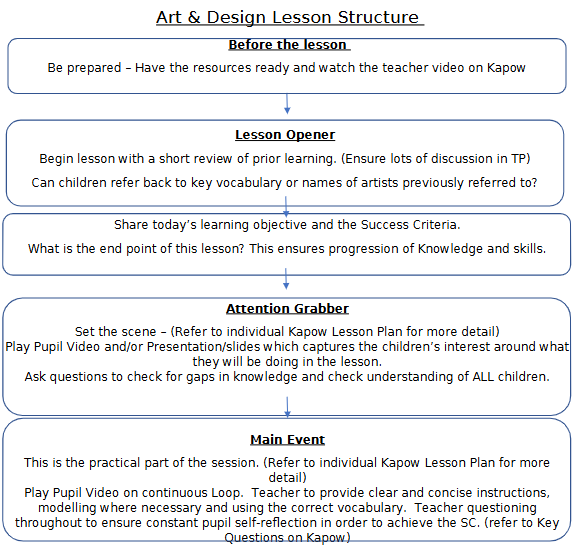
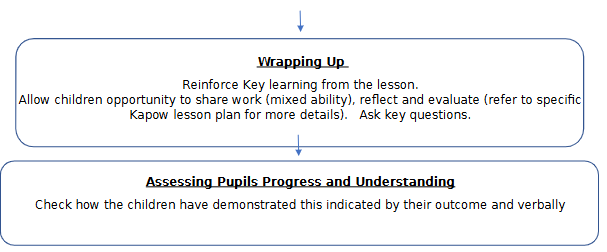
As part of our Enrichment Days the children at Haslam Park complete creative activities. This is a great way to teach skills through a Cross Curricular approach. Since September, we have taken part in Black History Week, Space Week, Road Safety Awareness Week, Diwali and Christmas Celebration Days. Take a look at the gallery below to see some of the Art we have produced as part of these enrichment days.
Art & Design Displays Around Our School